
Assess
Field baseline incomplete
Soil tests, crop context, climate, NDVI, pest observations and management data are held in separate systems. The field baseline is rarely current when decisions are made.

Mutus Tech
Mutus Tech combines Parallel Farm and Pezego to help farms, advisers and programme partners connect fertiliser planning, pest intelligence, crop monitoring, field tasks and evidence-ready reporting.
The scaling problem
Assess
Soil tests, crop context, climate, NDVI, pest observations and management data are held in separate systems. The field baseline is rarely current when decisions are made.
Plan & act
Fertiliser plans, pest observations and agronomic recommendations stay in PDFs, spreadsheets, messages or separate mobile tools — disconnected from the field they belong to.
Report
Input records, pest findings, NDVI timelines, task completion and reports live in fragments. It is hard to connect them back to the same field and season.
The Mutus approach
The same digital field boundary links assessment, planning, execution, monitoring and reporting. Fertiliser plans, pest observations, NDVI timelines, farm tasks and evidence records stay linked to the field and season they belong to.
Establish the field-level baseline — soil chemistry, crop context, climate, NDVI, pest observations and farm records — on one digital field boundary.
Generate fertiliser plans, crop-health monitoring routines and seasonal field actions per field, with yield and environmental-performance estimates.
Publish recommendations as Farm Tasks, capture mobile pest observations through Pezego, and log inputs, photos and completion in the field.
Track NDVI, crop condition, pest signals from Pezego, plan compliance and deviations within the season.
Compile field evidence for agronomists, farm groups, supply chains and project partners — linked back to the same field and season.
The digital field boundary is the unit at every stage, so evidence is created during the workflow rather than reconstructed after it.
This is the operating logic behind Parallel Farm and Pezego.
Our products
Parallel Farm manages field workflows and evidence. Pezego brings mobile pest and crop intelligence into the same operating record. Both are supported by Mutus Tech's shared AI, data and reporting platform.
Field operating platform
Generate field-level NPKS plans, run N-rate sensitivity checks, publish recommendations as farm tasks, capture NDVI timelines and keep applied inputs, crop observations and reports linked to the same field record.
Explore Parallel Farm →
Core productAI crop and pest intelligence
Mobile pest detection, contextual field diagnosis and crop-health support. Operates as a focused mobile product or connects with Parallel Farm to link pest observations to field records, tasks and reports. Co-developed with RSK ADAS, the University of Sheffield and the University of Liverpool, with related pest identification research peer-reviewed in IEEE Internet of Things Journal.
Explore Pezego →
Shared layerData, AI and reporting infrastructure
The mobile-cloud architecture, digital field boundary data model, AI model services and reporting pipelines that support Parallel Farm, Pezego and future agricultural intelligence modules.
Explore the platform →
Live modules
These are real surfaces across Parallel Farm and Pezego — not concepts. Screenshots throughout are taken from the production environment.
Field operating platform
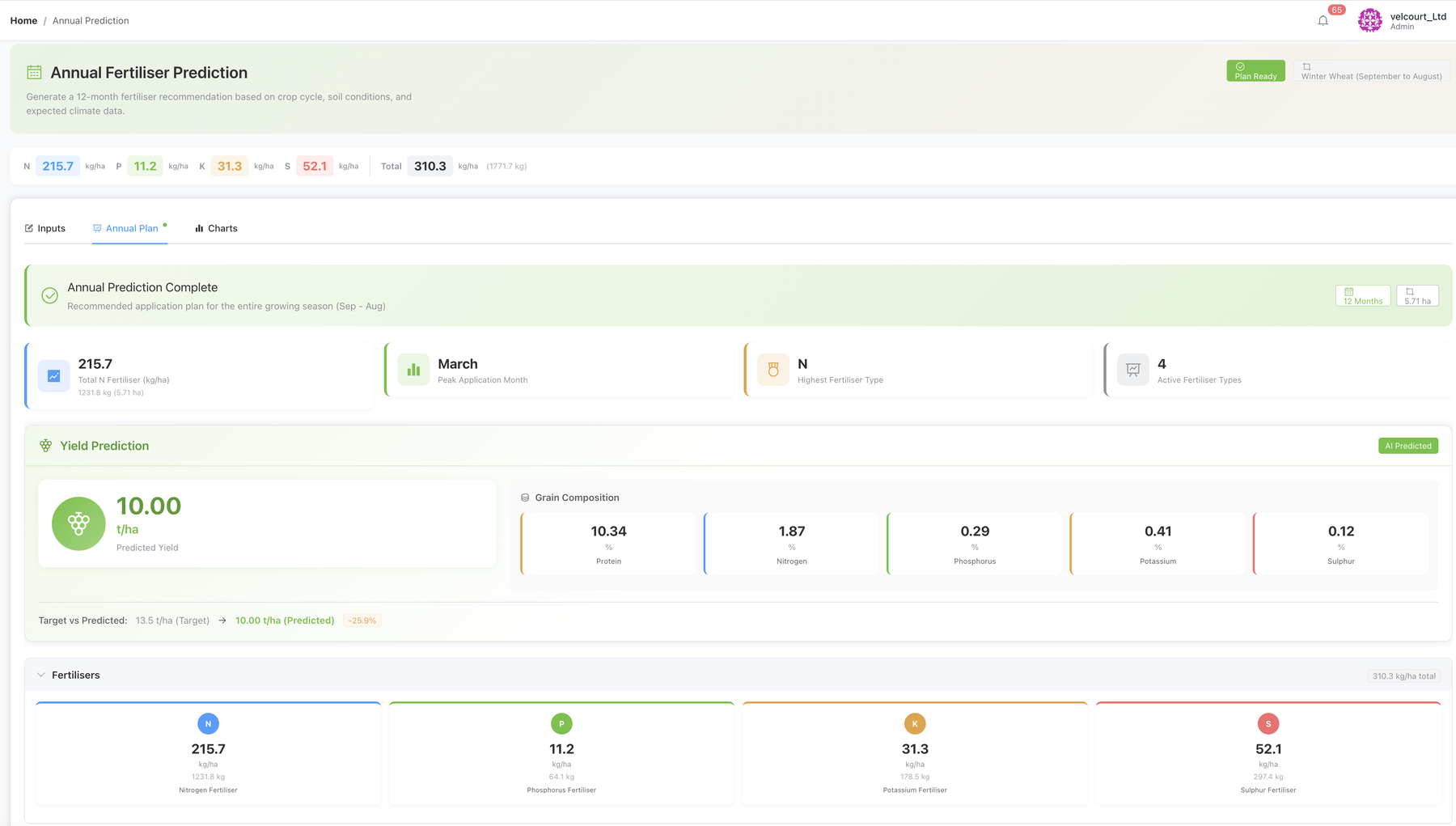
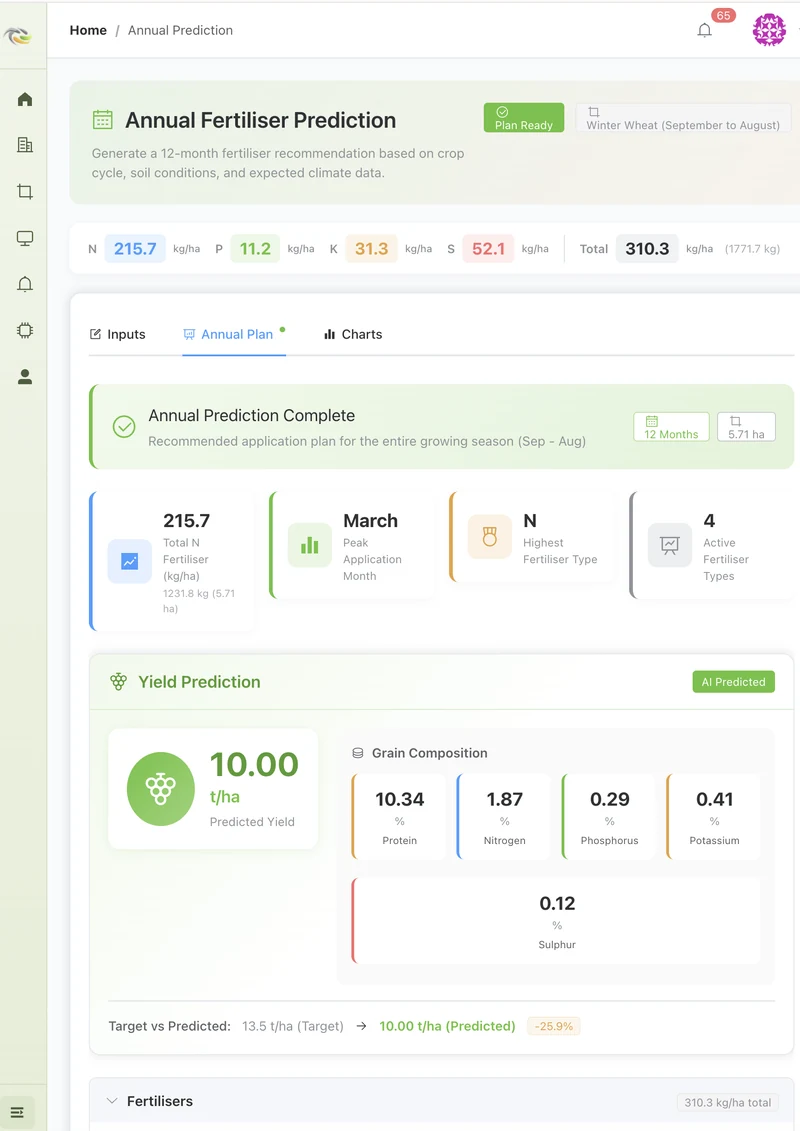
Generate a 12-month N/P/K/S plan per field, with yield and grain-quality estimates for review and adjustment.
Planning
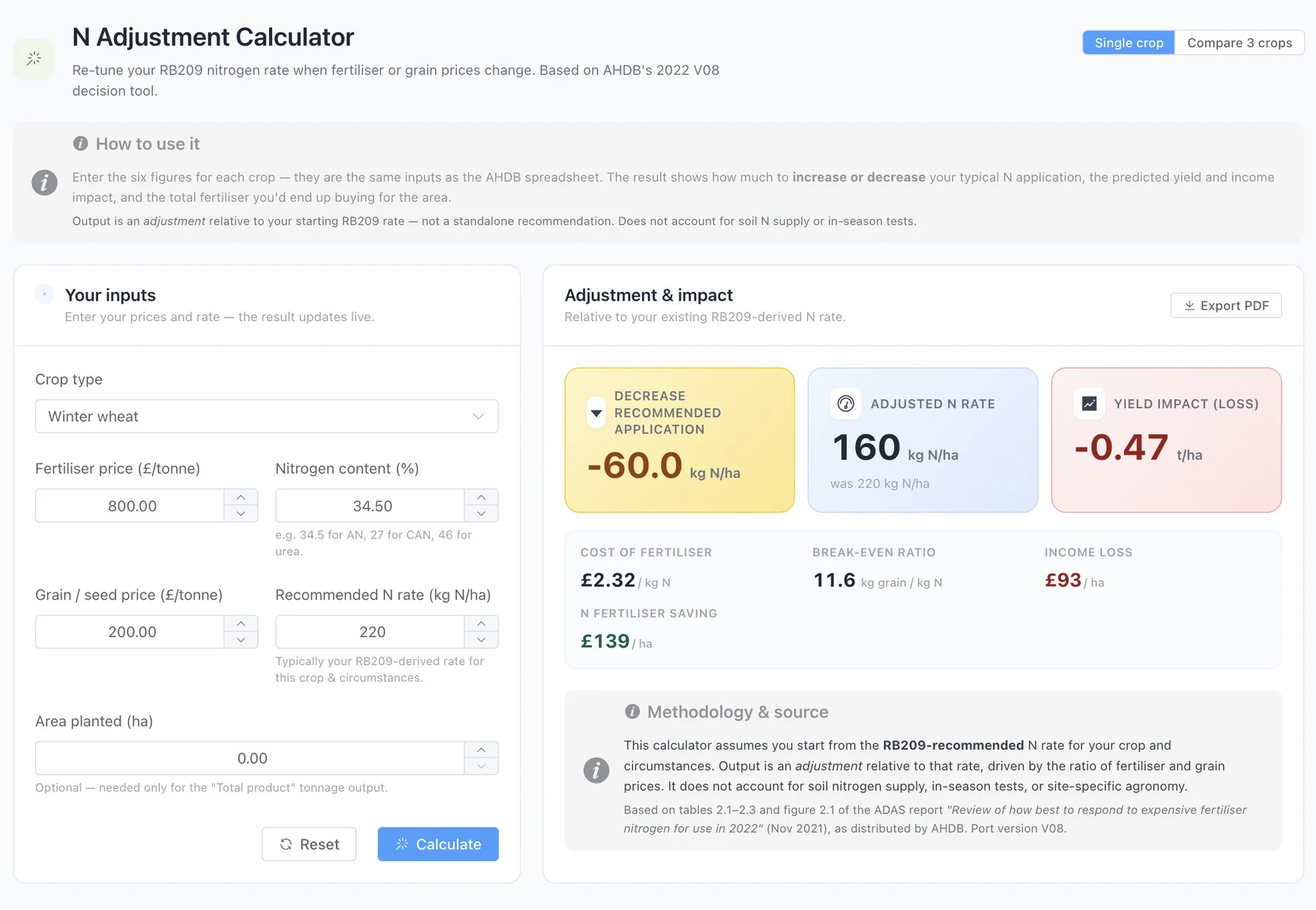
Economic sensitivity checks around an agronomically derived N rate when fertiliser or grain prices change.
Planning
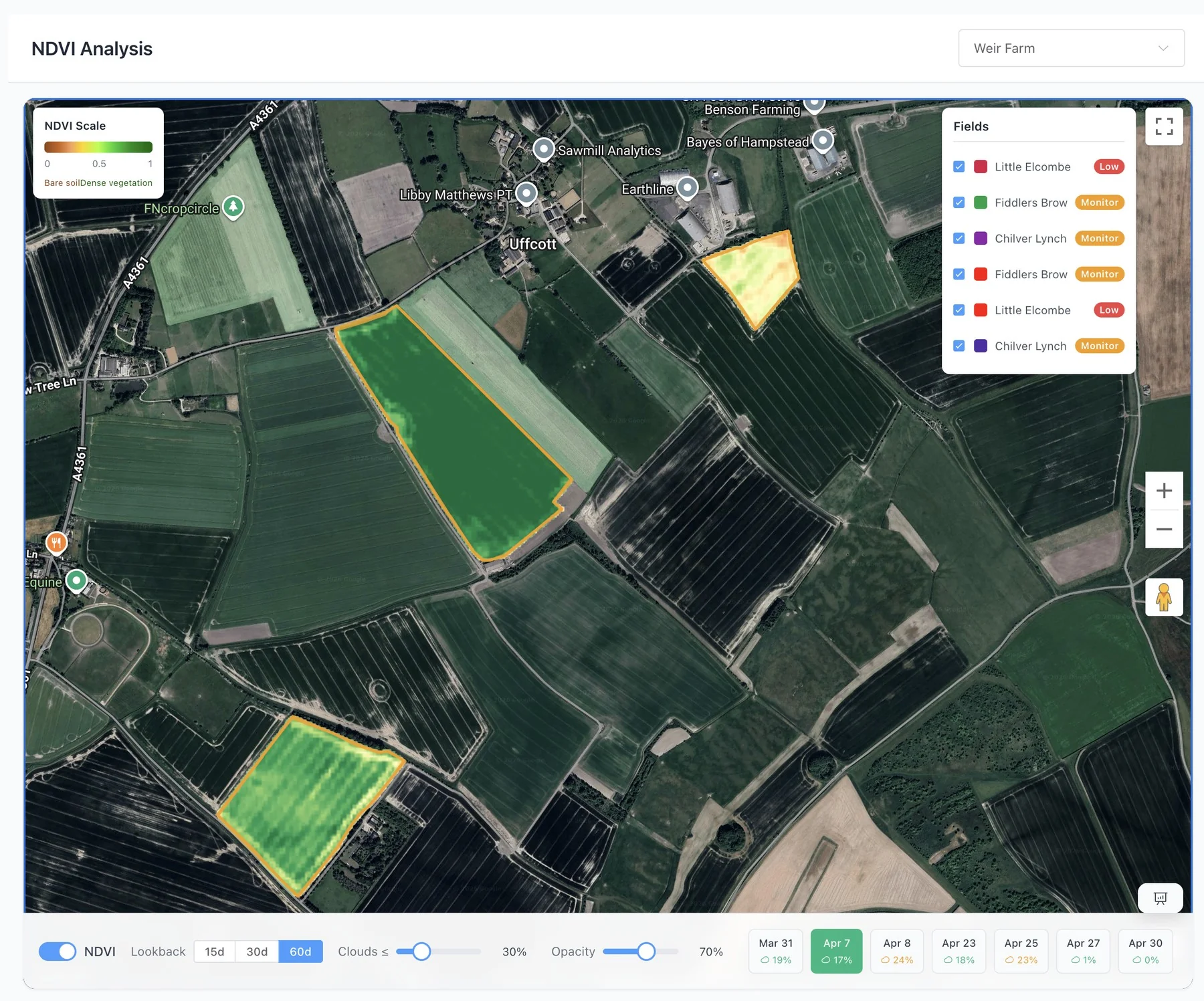
Per-polygon vegetation-vigour timelines using Sentinel-2 Copernicus imagery, refreshed approximately every five days subject to cloud cover.
Monitoring
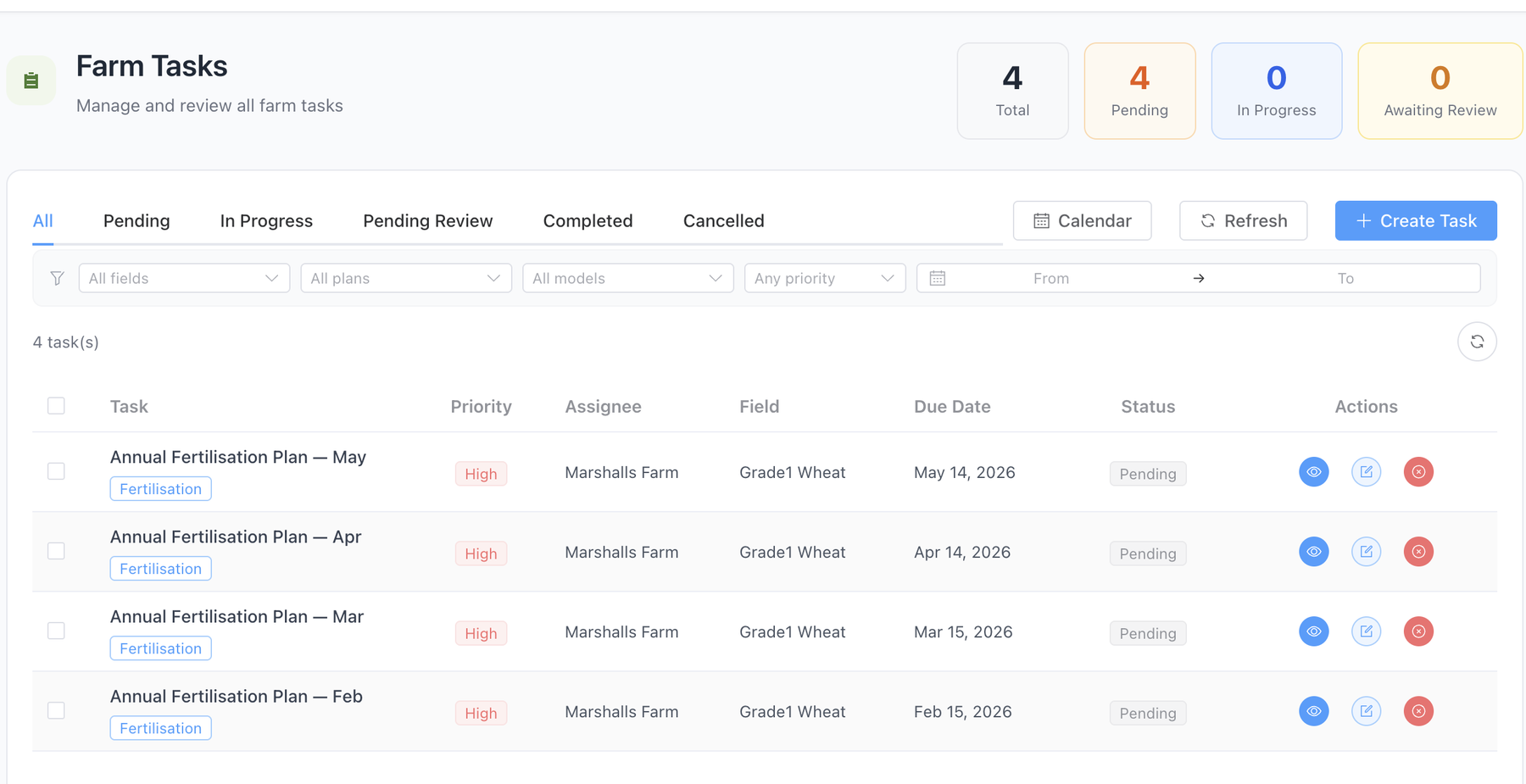
Recommendations published as field-level work orders with timing, rate, owner and status.
Execution
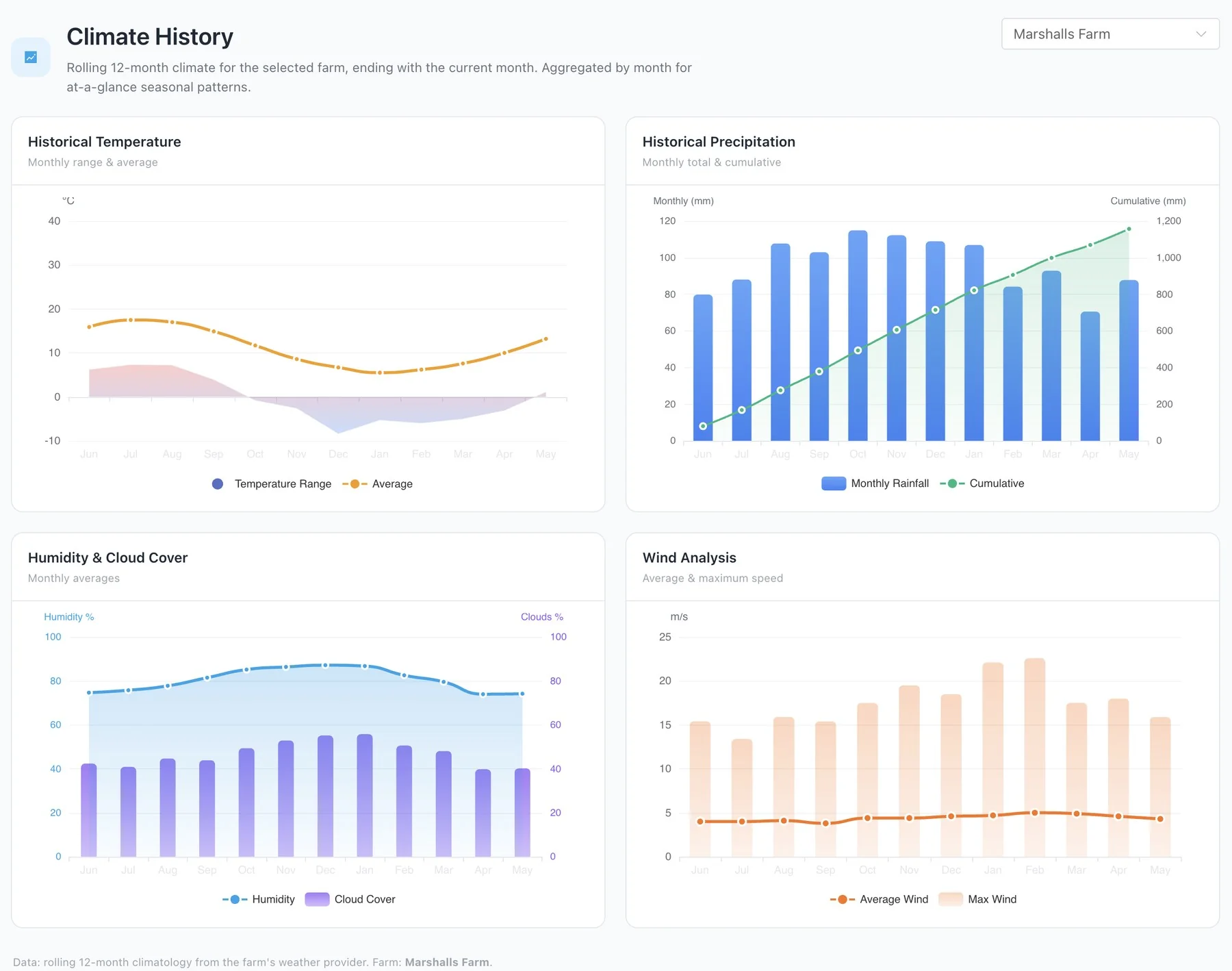
Per-field temperature, rainfall and radiation history feeding plan assumptions and review.
Monitoring
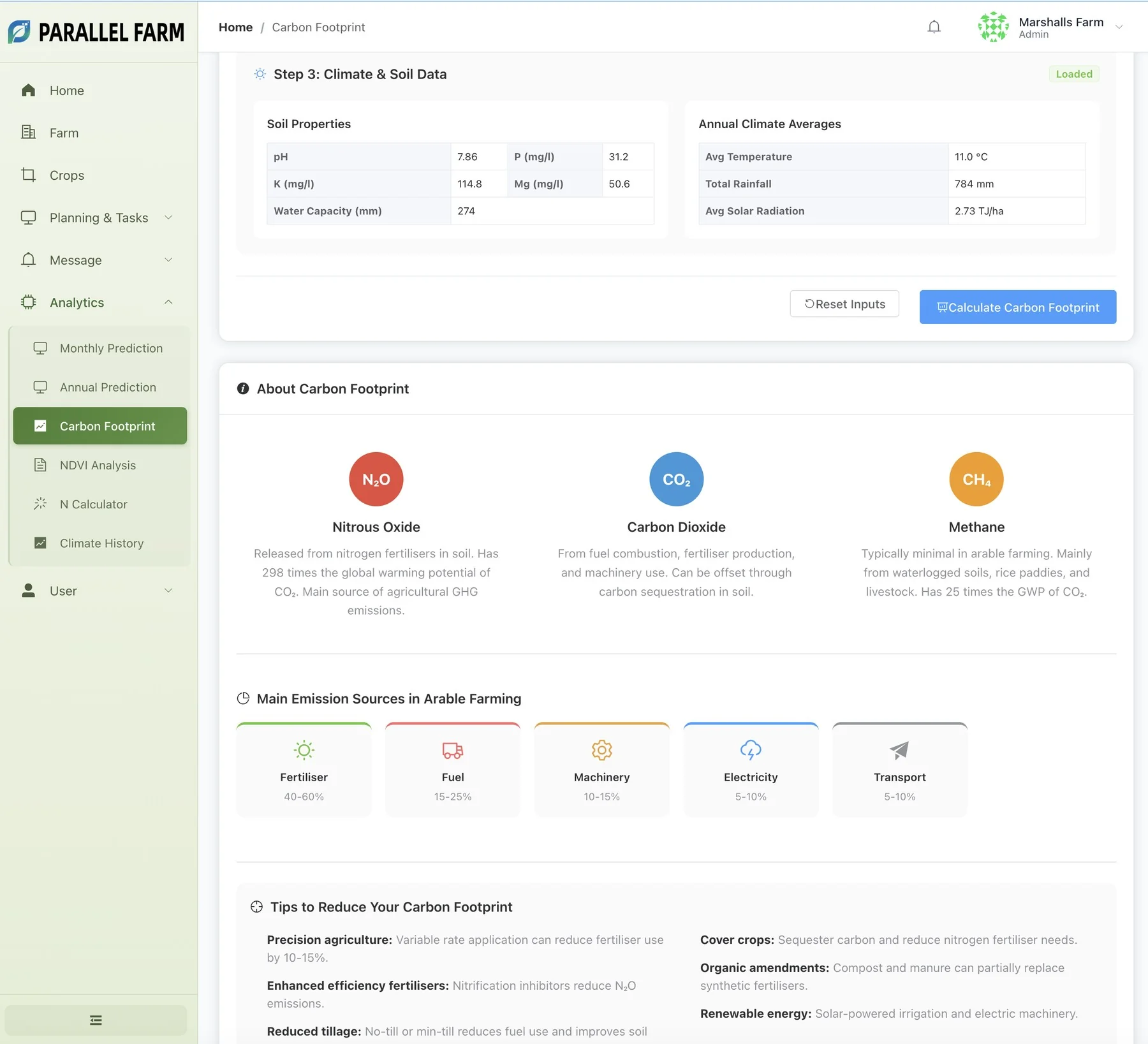
Per-field GHG estimation from fertiliser, fuel and machinery use to support environmental-performance review. Not self-issued MRV or carbon-credit certification.
Evidence
AI crop and pest intelligence
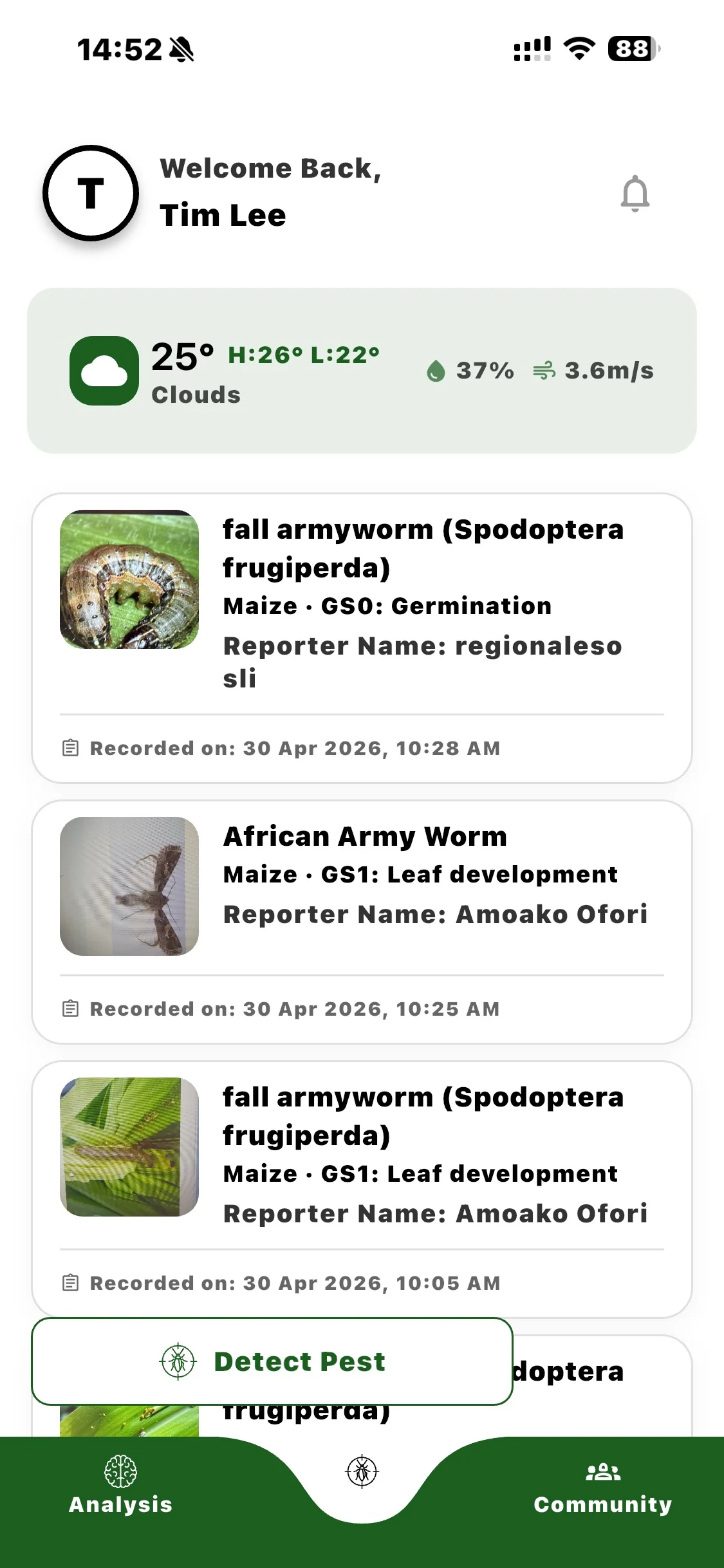
In-field photo capture and AI-supported pest identification with confidence scoring, anchored to a configured pest taxonomy for the deployment region.
Capture
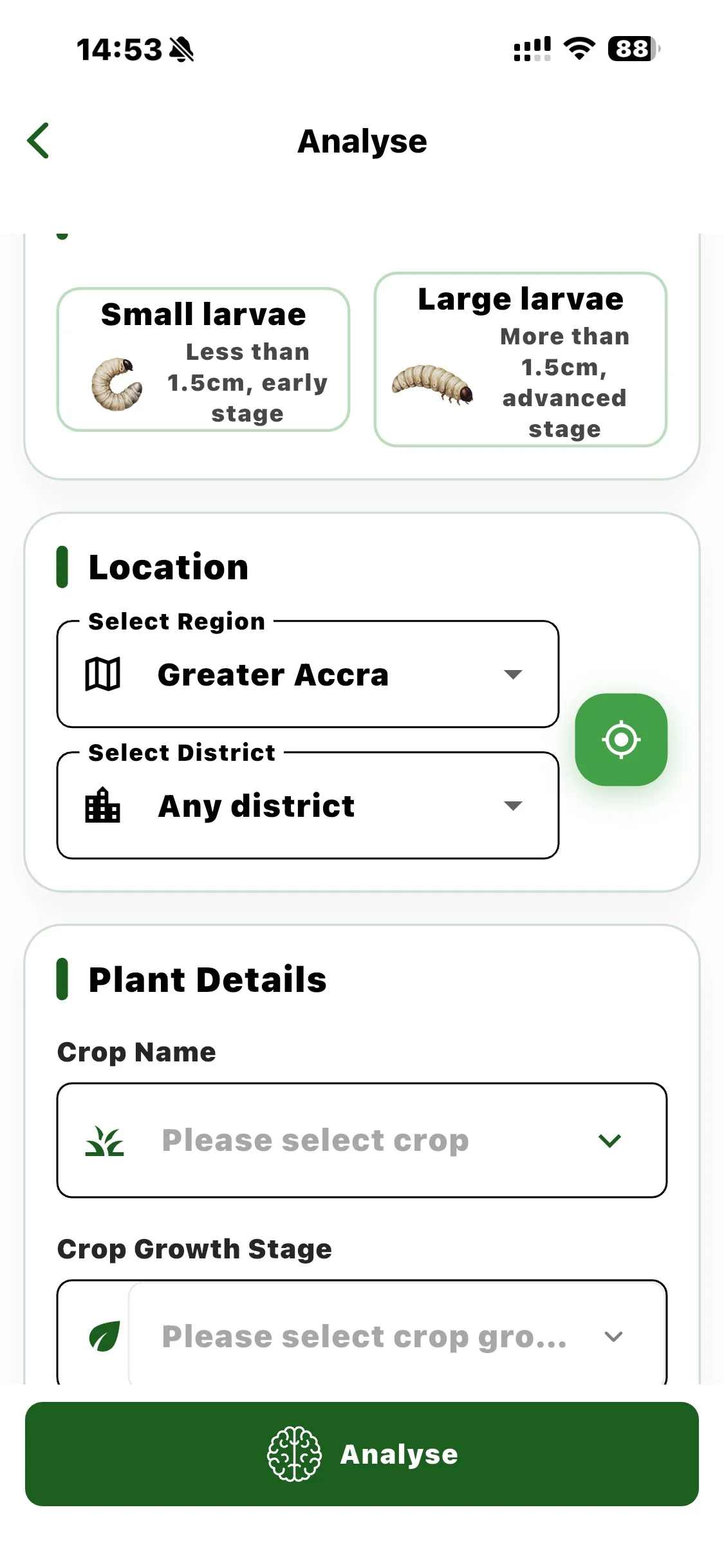
Combine pest findings with crop, growth stage, location and seasonal weather context for field-level review.
Monitoring
Pest observation
Fall armyworm
Maize · V6 (vegetative)
GPS-linked, weather-stamped pest observations saved as structured records that can feed adviser review, Parallel Farm tasks and partner reporting.
Evidence
These product modules are supported by field records, pest image datasets, funded research and partner calibration — detailed below.
Data and research foundation
131
Field records for platform calibration
Field-level soil, crop, climate and management records used for Parallel Farm calibration, research alignment and partner review. Dataset composition can be shared with partners during pilot and due diligence discussions.
10,000+
Annotated pest images
Collected from 20+ UK farms over two seasons across 38 pests and 10 field crops, supporting the Pezego pest identification research published in IEEE Internet of Things Journal.
£710K+
UKRI / Innovate UK award
Active Climate-Smart Fertiliser consortium project from January 2024 to September 2026, calibrating field-level nutrient planning with academic partners.
Boundary note
Datasets are used for research, model development and pilot calibration. Field-level outputs remain subject to agronomic context and partner validation. Soil health interpretation combines NDVI signals with soil tests and management records. Carbon Footprint figures are environmental performance estimates, not self-issued MRV or carbon credit certification.
Validation
UKRI / Innovate UK
Jan 2024 – Sep 2026 · £710K+ total funding award. Calibrating field-level nutrient planning and climate-smart practice with academic partners.
Pezego · IEEE Internet of Things Journal
Co-developed with RSK ADAS, University of Sheffield and University of Liverpool. 20+ farms · 10,000+ annotated images · 38 pests · 10 crops.
Parallel Farm · IEEE INDIN 2025
Integrated as a Parallel Farm microservice for environmental-performance modelling. University of Sheffield + Mutus Tech.
BridgeAI / Innovate UK
External programme support for AI scale-up and technical collaboration in agri-food.
The Alan Turing Institute
Mutus Tech is paired with Professor Po Yang of the University of Sheffield, through the Turing Institute’s Independent Scientific Advisor programme — delivered under BridgeAI / Innovate UK support.
Innovate UK Business Connect
Mutus Tech profiled by Innovate UK Business Connect as a BridgeAI participant building AI-driven precision agriculture, with a structured evaluation of Pezego showing measurable improvements in diagnostic accuracy and processing time.
Independent perspective
Mutus Tech's advanced, AI-driven agricultural data science solutions address some of the key challenges in modern farming.
Professor Po Yang
University of Sheffield
Mutus Tech's Independent Scientific Advisor, paired through The Alan Turing Institute's programme under BridgeAI / Innovate UK support.
Adopters
Manage nutrients, pest observations and crop health from one operating record across multiple fields.
Multi-farm nutrient and pest planning aligned with recognised UK agronomic references where relevant, plus NDVI evidence and scenario modelling.
A portfolio operating layer — plans, tasks, pest records, observations and reports across estates.
Pezego mobile field diagnosis and Parallel Farm records combined into structured pest-pressure evidence.
Sourcing, insetting and sustainability evidence drawn from field-level nutrient, pest and crop-response data.
Regional deployment for extension officers and pilot programmes — Pezego mobile + Parallel Farm web.
Partners
Universities and applied-research bodies we co-develop modules and validate science with.





Funded programmes and consortia that back our research and product development.


Industry collaborators, technology partners and ecosystem organisations.



Latest updates
 International programme
Featured update
24 June 2026
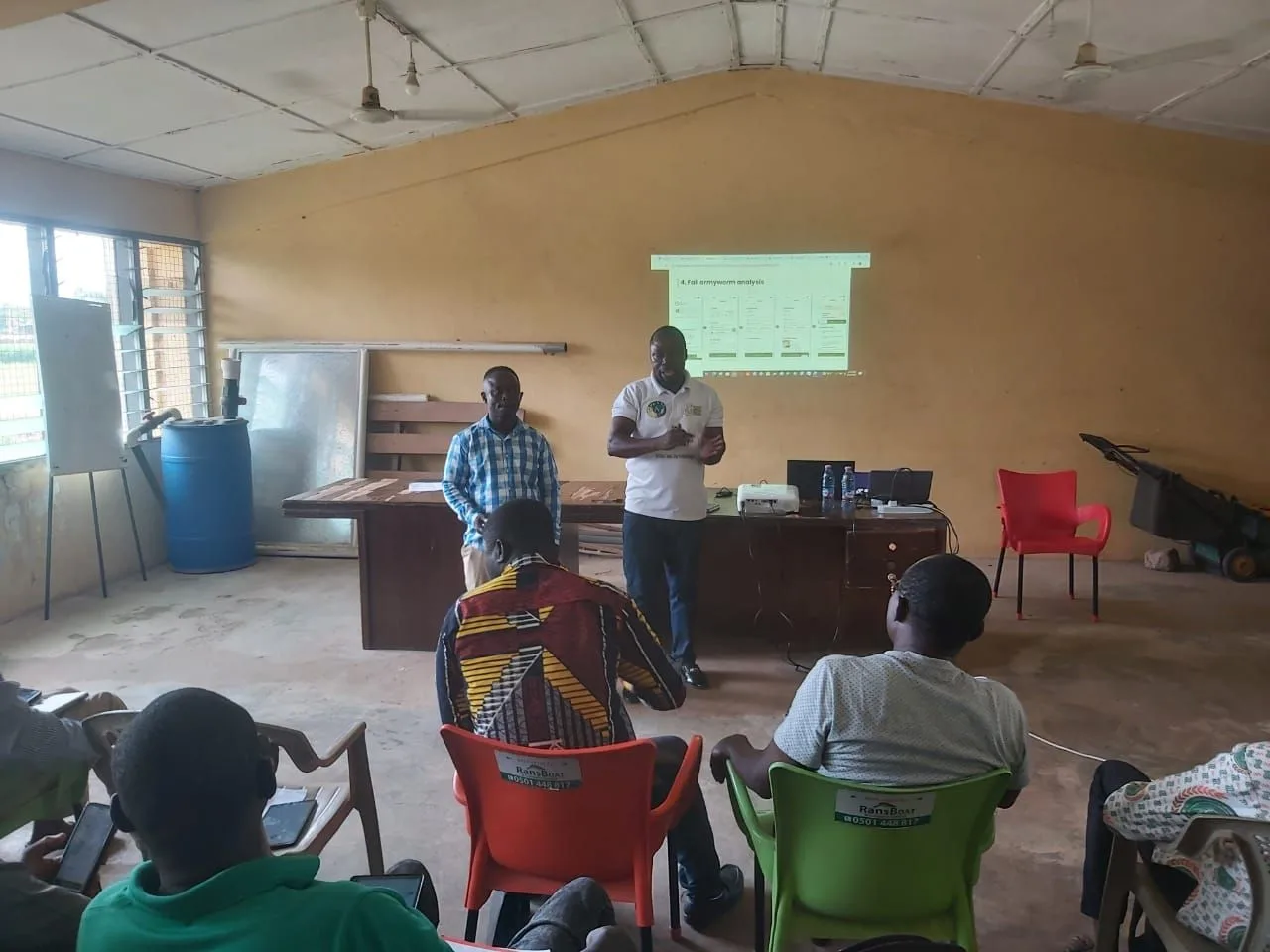
Working with partners including the University of Sheffield and the University of Ghana, Mutus Tech delivered hands-on Pezego training for Extension Service Officers at the Ejura Agricultural Station — an early step towards scaling AI-assisted pest surveillance across the Ashanti region.
 Case study
1 April 2026
Innovate UK Business Connect profiled Mutus Tech's BridgeAI participation, Alan Turing Institute Scientific Advisor support and a structured Pezego evaluation — reporting a 15 percent improvement in diagnostic accuracy and 20 percent faster processing under the tested conditions.
 Event
Event8 June 2025
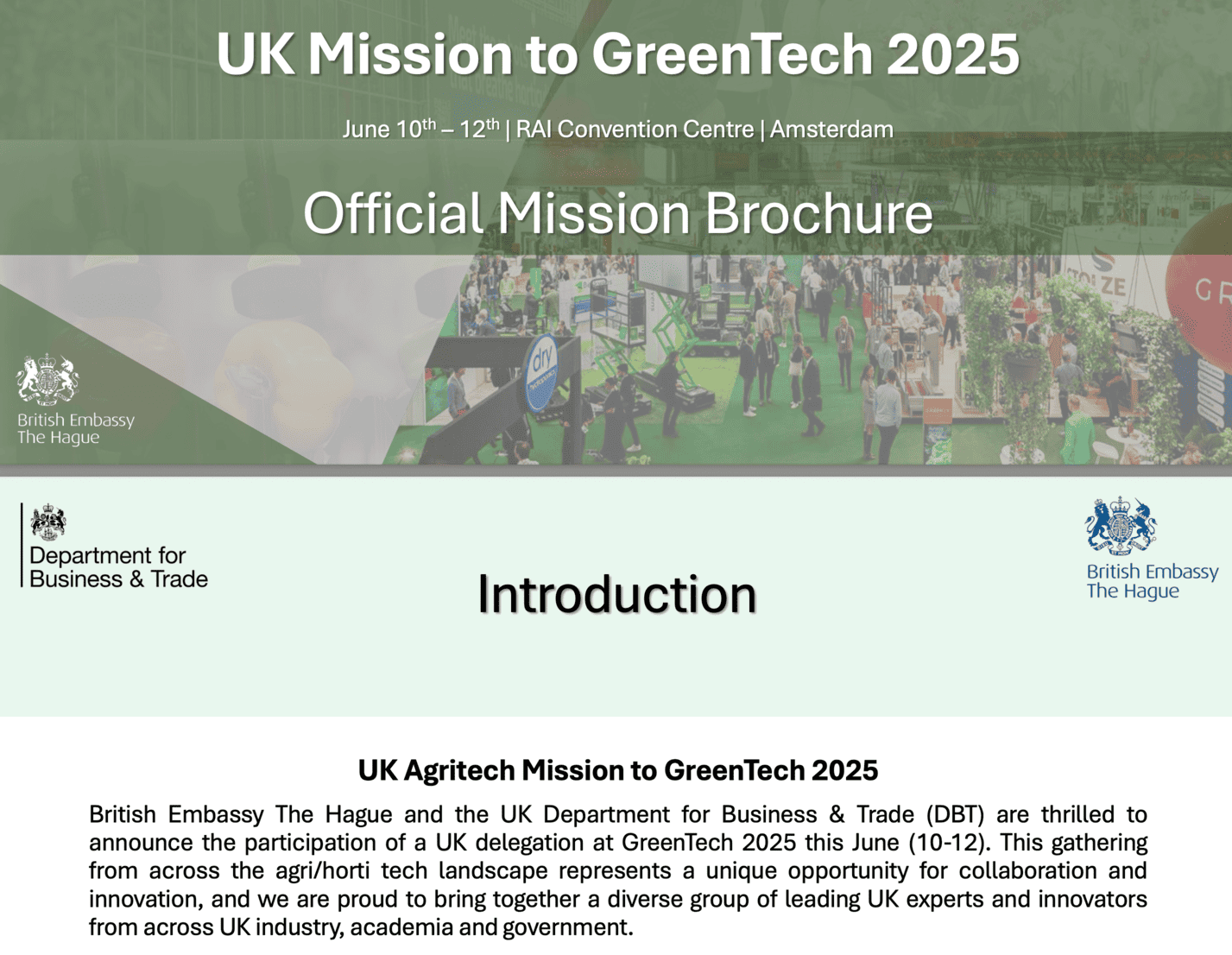
Mutus Tech joined the official UK delegation to GreenTech 2025 in Amsterdam (10–12 June), alongside other UK agritech and horticulture innovators.
Work with us
We are prioritising pilots where fertiliser planning, pest observations and evidence reporting can be tested on defined fields within one season — alongside three kinds of partners.
01
Farms, farm groups and smallholder programmes ready to run fertiliser planning, pest observations, crop monitoring and reporting on defined fields for one season.
02
Agronomists, soil advisers, crop-protection specialists, certifiers and standards bodies to co-design evidence workflows that plug into partner-validated reviews.
03
Buyers, funders and public-sector programmes ready to convert field-level fertiliser, pest and crop-health evidence into follow-on commitments.